
Goldwork / Metal Threads

Price range: $12.01 through $12.43 USDSelect options This product has multiple variants. The options may be chosen on the product page
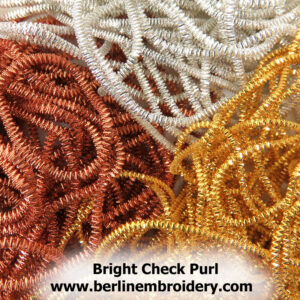
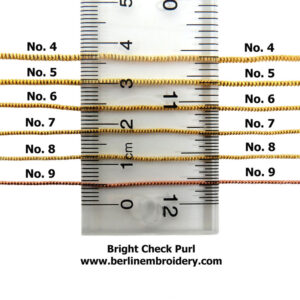
Bullion – Bright Check Purl
Price Per Yard. Available in Gilt, Silver and Copper.
Bright Check Purls are made up of a very fine wire thread that is wound into a soft flexible hollow tube with a serrated/jaggered and shiny surface.
The tube is cut up into chips (beads) and couched down onto the fabric – passing the needle and thread through the middle of the chip so the thread is hidden and can be sewn over felt or crochet cotton padding to give the area dimension.
I recommend ordering enough for your project as each manufacturing batch can differ slightly in the appearance of the serrated/jaggered surface and colour.
Bullion – Bright Check Purl
Price Per Yard. Available in Gilt, Silver and Copper.
Bright Check Purls are made up of a very fine wire thread that is wound into a soft flexible hollow tube with a serrated/jaggered and shiny surface.
The tube is cut up into chips (beads) and couched down onto the fabric – passing the needle and thread through the middle of the chip so the thread is hidden and can be sewn over felt or crochet cotton padding to give the area dimension.
I recommend ordering enough for your project as each manufacturing batch can differ slightly in the appearance of the serrated/jaggered surface and colour.
Price range: $12.01 through $12.43 USDSelect options This product has multiple variants. The options may be chosen on the product page
Price range: $8.28 through $9.94 USDSelect options This product has multiple variants. The options may be chosen on the product page
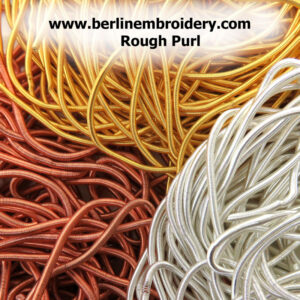
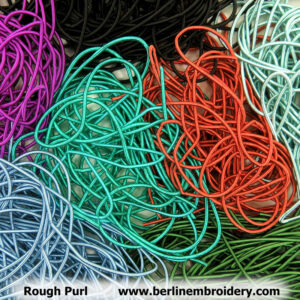
Bullion – Rough Purl
Price Per Yard. Available in Gold 2%, Gilt, Silver, Copper and a variety of colours.
Rough Purls are made up of a very fine wire thread that is wound into a soft flexible hollow tube with a dull (matte) surface.
The tube is cut up into chips (beads) and couched down onto the fabric – passing the needle and thread through the middle of the chip so the thread is hidden and can be sewn over felt or crochet cotton padding to give the area dimension,
I recommend ordering enough for your project as each manufacturing batch can differ slightly in colour.
Bullion – Rough Purl
Price Per Yard. Available in Gold 2%, Gilt, Silver, Copper and a variety of colours.
Rough Purls are made up of a very fine wire thread that is wound into a soft flexible hollow tube with a dull (matte) surface.
The tube is cut up into chips (beads) and couched down onto the fabric – passing the needle and thread through the middle of the chip so the thread is hidden and can be sewn over felt or crochet cotton padding to give the area dimension,
I recommend ordering enough for your project as each manufacturing batch can differ slightly in colour.
Price range: $8.28 through $9.94 USDSelect options This product has multiple variants. The options may be chosen on the product page
Price range: $7.87 through $9.94 USDSelect options This product has multiple variants. The options may be chosen on the product page
Bullion – Smooth Purl
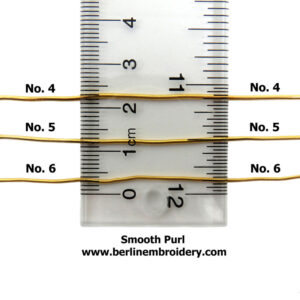
Price Per Yard. Available in Gold 2%, Gilt, Silver and Copper.
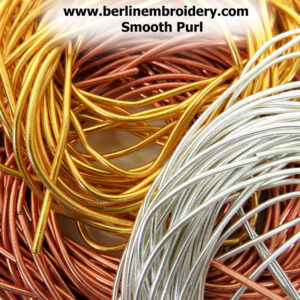
Smooth Purls are made up of a very fine wire thread that is wound into a soft flexible hollow tube with a smooth and shiny surface.
The tube is cut up into chips (beads) and couched down onto the fabric – passing the needle and thread through the middle of the chip so the thread is hidden and can be sewn over felt or crochet cotton padding to give the area dimension.
I recommend ordering enough for your project as each manufacturing batch can differ slightly in colour.
Bullion – Smooth Purl
Price Per Yard. Available in Gold 2%, Gilt, Silver and Copper.
Smooth Purls are made up of a very fine wire thread that is wound into a soft flexible hollow tube with a smooth and shiny surface.
The tube is cut up into chips (beads) and couched down onto the fabric – passing the needle and thread through the middle of the chip so the thread is hidden and can be sewn over felt or crochet cotton padding to give the area dimension.
I recommend ordering enough for your project as each manufacturing batch can differ slightly in colour.
Price range: $7.87 through $9.94 USDSelect options This product has multiple variants. The options may be chosen on the product page
Price range: $8.28 through $12.43 USDSelect options This product has multiple variants. The options may be chosen on the product page
Bullion – Wire Check Purl
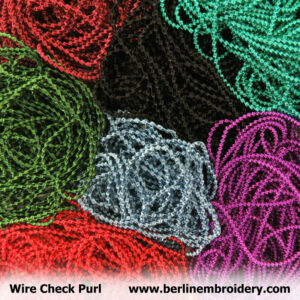
Price Per Yard. Available in Gold 2%, Gilt, Silver, Copper and a variety of colours.
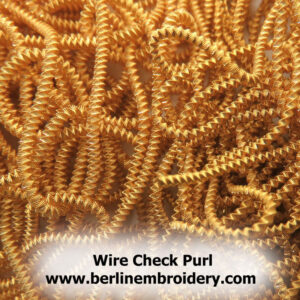
Wire Check Purls are made up of a very fine wire thread that is wound into a soft flexible hollow tube with a serrated/jaggered dull (matte) surface.
The tube is cut up into chips (beads) and couched down onto the fabric – passing the needle and thread through the middle of the chip so the thread is hidden and can be sewn over felt or crochet cotton padding to give the area dimension.
I recommend ordering enough for your project as each manufacturing batch can differ slightly in the appearance of the serrated/jaggered surface and colour.
Bullion – Wire Check Purl
Price Per Yard. Available in Gold 2%, Gilt, Silver, Copper and a variety of colours.
Wire Check Purls are made up of a very fine wire thread that is wound into a soft flexible hollow tube with a serrated/jaggered dull (matte) surface.
The tube is cut up into chips (beads) and couched down onto the fabric – passing the needle and thread through the middle of the chip so the thread is hidden and can be sewn over felt or crochet cotton padding to give the area dimension.
I recommend ordering enough for your project as each manufacturing batch can differ slightly in the appearance of the serrated/jaggered surface and colour.
Price range: $8.28 through $12.43 USDSelect options This product has multiple variants. The options may be chosen on the product page
$12.43 USDSelect options This product has multiple variants. The options may be chosen on the product page
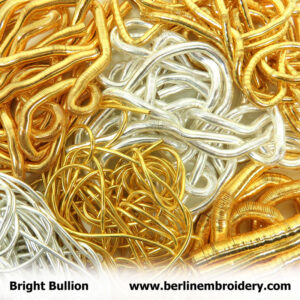
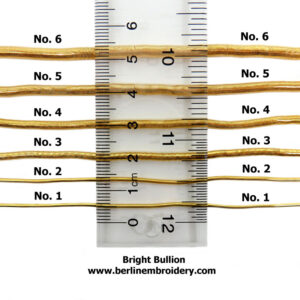
Bullion Thread (Large) – Bright Bullion
Bright Bullions are made up of a very fine wire thread that is wound into a soft flexible hollow tube with a smooth and shiny surface.
The tube is cut up into chips (beads) and couched down onto the fabric – passing the needle and thread through the middle of the chip so the thread is hidden and can be sewn over felt or crochet cotton padding to give the area dimension.
Bullion Thread (Large) – Bright Bullion
Bright Bullions are made up of a very fine wire thread that is wound into a soft flexible hollow tube with a smooth and shiny surface.
The tube is cut up into chips (beads) and couched down onto the fabric – passing the needle and thread through the middle of the chip so the thread is hidden and can be sewn over felt or crochet cotton padding to give the area dimension.
$12.43 USDSelect options This product has multiple variants. The options may be chosen on the product page
$12.43 USDSelect options This product has multiple variants. The options may be chosen on the product page
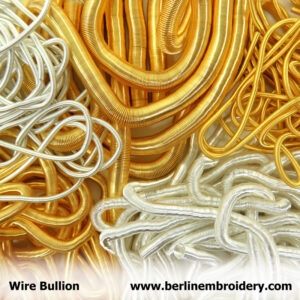
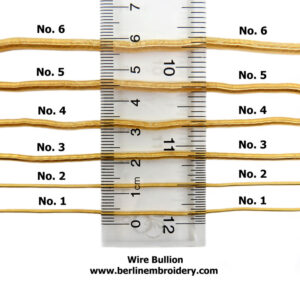
Bullion Thread (Large) – Wire Bullion
Available in Gilt and Silver.
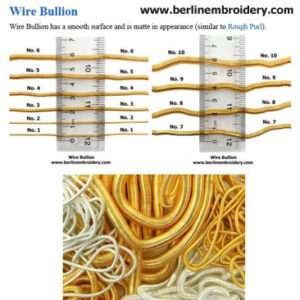
Wire Bullions are made up of a very fine wire thread that is wound into a soft flexible hollow tube with a smooth and dull (matte) surface.
The tube is cut up into chips (beads) and couched down onto the fabric – passing the needle and thread through the middle of the chip so the thread is hidden and can be sewn over felt or crochet cotton padding to give the area dimension.
Bullion Thread (Large) – Wire Bullion
Available in Gilt and Silver.
Wire Bullions are made up of a very fine wire thread that is wound into a soft flexible hollow tube with a smooth and dull (matte) surface.
The tube is cut up into chips (beads) and couched down onto the fabric – passing the needle and thread through the middle of the chip so the thread is hidden and can be sewn over felt or crochet cotton padding to give the area dimension.
$12.43 USDSelect options This product has multiple variants. The options may be chosen on the product page
$13.26 USDSelect options This product has multiple variants. The options may be chosen on the product page
Bullion Thread (Large): Bright Check Bullion
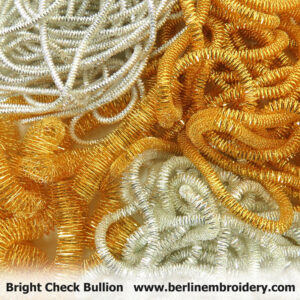
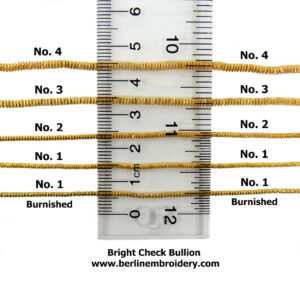
Bright Check Bullions are available in gilt and silver and are made up of a very fine wire thread that is wound into a soft flexible hollow tube with a jaggered/serrated and shiny surface.
The tube is cut up into chips (beads) and couched down onto the fabric – passing the needle and thread through the middle of the chip so the thread is hidden and can be sewn over felt or crochet cotton padding to give the area dimension.
Bullion Thread (Large): Bright Check Bullion
Bright Check Bullions are available in gilt and silver and are made up of a very fine wire thread that is wound into a soft flexible hollow tube with a jaggered/serrated and shiny surface.
The tube is cut up into chips (beads) and couched down onto the fabric – passing the needle and thread through the middle of the chip so the thread is hidden and can be sewn over felt or crochet cotton padding to give the area dimension.
$13.26 USDSelect options This product has multiple variants. The options may be chosen on the product page
Price range: $6.63 through $99.41 USDSelect options This product has multiple variants. The options may be chosen on the product page
Check Thread (Crinkle Cordonnet)
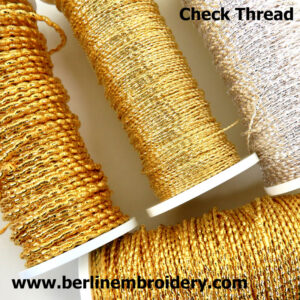
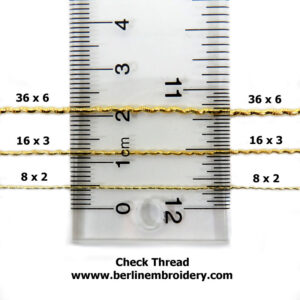
Check thread also known as Crinkle Cordonnet in French is made up of a fine metal wire wrapped around a fibre core. The thread has a wavy (kinked) serpentine appearance and is similar to Rococco but has a closer wave.
Visit the Metal Thread Information page of my website for further information and pictures on how the thread can be used on an embroidery and FAQ about metal threads.
Check Thread (Crinkle Cordonnet)
Check thread also known as Crinkle Cordonnet in French is made up of a fine metal wire wrapped around a fibre core. The thread has a wavy (kinked) serpentine appearance and is similar to Rococco but has a closer wave.
Visit the Metal Thread Information page of my website for further information and pictures on how the thread can be used on an embroidery and FAQ about metal threads.
Price range: $6.63 through $99.41 USDSelect options This product has multiple variants. The options may be chosen on the product page
$8.28 USDSelect options This product has multiple variants. The options may be chosen on the product page
Cords – Gimp
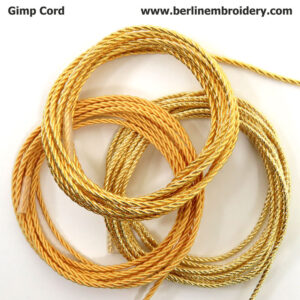
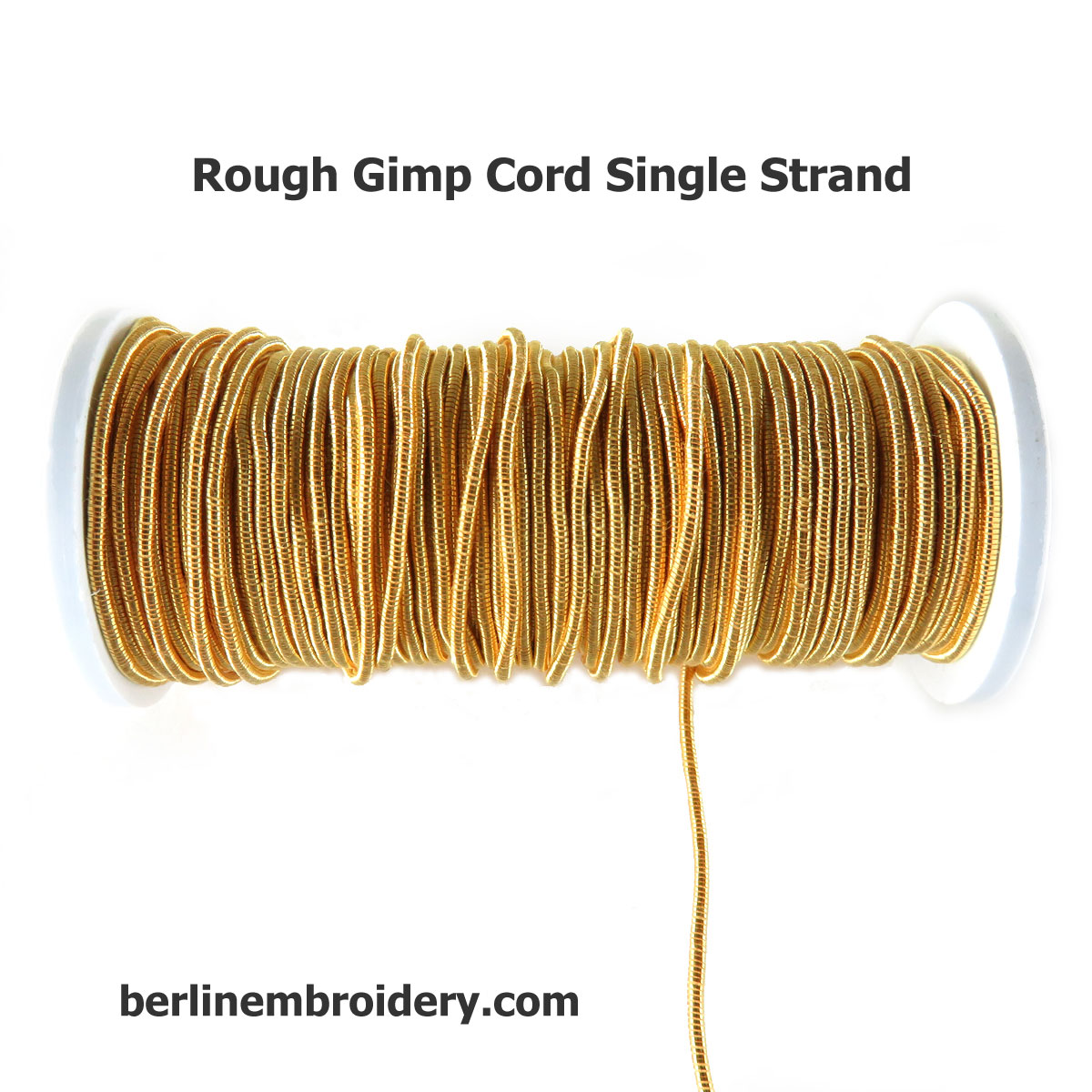
Gimp cords are made up of a single strand or of three individual strands twisted together to make a cord. Makes a great outlining thread.
See Sale Metal Threads for a range of shorter than one yard lengths.
Visit the Metal Thread Information page of my website for further information and pictures on how the thread can be used on an embroidery and FAQ about metal threads.
Cords – Gimp
Gimp cords are made up of a single strand or of three individual strands twisted together to make a cord. Makes a great outlining thread.
See Sale Metal Threads for a range of shorter than one yard lengths.
Visit the Metal Thread Information page of my website for further information and pictures on how the thread can be used on an embroidery and FAQ about metal threads.
$8.28 USDSelect options This product has multiple variants. The options may be chosen on the product page
Price range: $8.28 through $18.23 USDSelect options This product has multiple variants. The options may be chosen on the product page
Cords – Grecian Twist
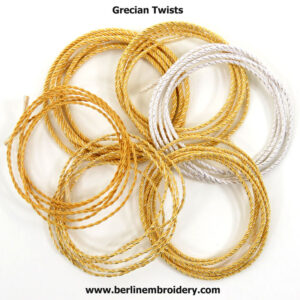
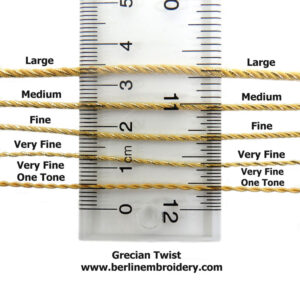
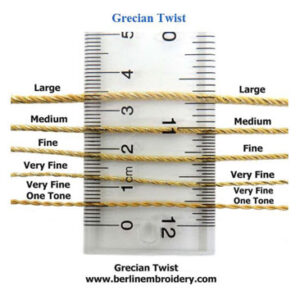
Grecian Twists are a two toned twisted cord. The twists alternate between a shiny, serrated surface and a smooth, matt surface. The Very Fine Grecian Twist also comes as a one toned cord with a smooth, matt surface.
Grecian Twists make a great outlining thread.
Visit the Metal Thread Information page of my website for further information and pictures on how the thread can be used on an embroidery and FAQ about metal threads.
Cords – Grecian Twist
Grecian Twists are a two toned twisted cord. The twists alternate between a shiny, serrated surface and a smooth, matt surface. The Very Fine Grecian Twist also comes as a one toned cord with a smooth, matt surface.
Grecian Twists make a great outlining thread.
Visit the Metal Thread Information page of my website for further information and pictures on how the thread can be used on an embroidery and FAQ about metal threads.
Price range: $8.28 through $18.23 USDSelect options This product has multiple variants. The options may be chosen on the product page
Price range: $2.49 through $6.63 USDSelect options This product has multiple variants. The options may be chosen on the product page
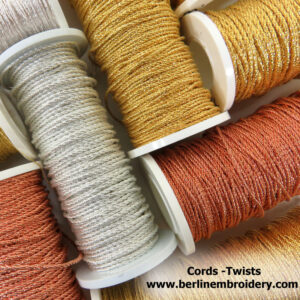
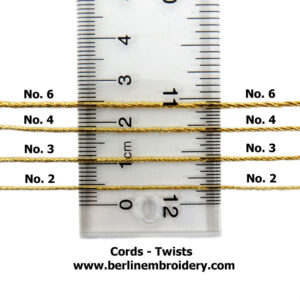
Cords – Twists
Twists also know as Torsades are cords that are made up of three strands. Each individual strand is made up of a fine metal wired wrapped around a fibre core. The three strands are twisted into a cord. The cords can be used as filling thread or an outlining thread.
Visit the Metal Thread Information page of my website for further information and pictures on how the thread can be used on an embroidery and FAQ about metal threads.
Cords – Twists
Twists also know as Torsades are cords that are made up of three strands. Each individual strand is made up of a fine metal wired wrapped around a fibre core. The three strands are twisted into a cord. The cords can be used as filling thread or an outlining thread.
Visit the Metal Thread Information page of my website for further information and pictures on how the thread can be used on an embroidery and FAQ about metal threads.
Price range: $2.49 through $6.63 USDSelect options This product has multiple variants. The options may be chosen on the product page
Price range: $2.90 through $29.00 USDSelect options This product has multiple variants. The options may be chosen on the product page
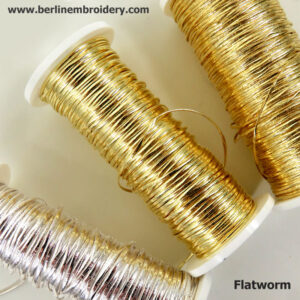
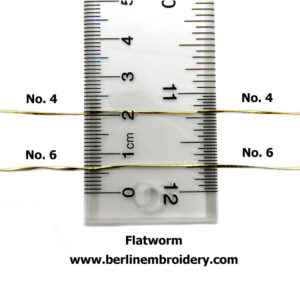
Flatworm
Flatworm is made up of a flattened metal strip wound around a fibre core and then lightly flattened so that the finished appearance is similar to broad plate but is more flexible and therefore easier to handle whilst stitching.
Flatworm thread is couched down singularly or two strands at a time as a filling or outline.
Flatworm
Flatworm is made up of a flattened metal strip wound around a fibre core and then lightly flattened so that the finished appearance is similar to broad plate but is more flexible and therefore easier to handle whilst stitching.
Flatworm thread is couched down singularly or two strands at a time as a filling or outline.
Price range: $2.90 through $29.00 USDSelect options This product has multiple variants. The options may be chosen on the product page
$4.14 USDSelect options This product has multiple variants. The options may be chosen on the product page
Gold Couching Thread – Metallic
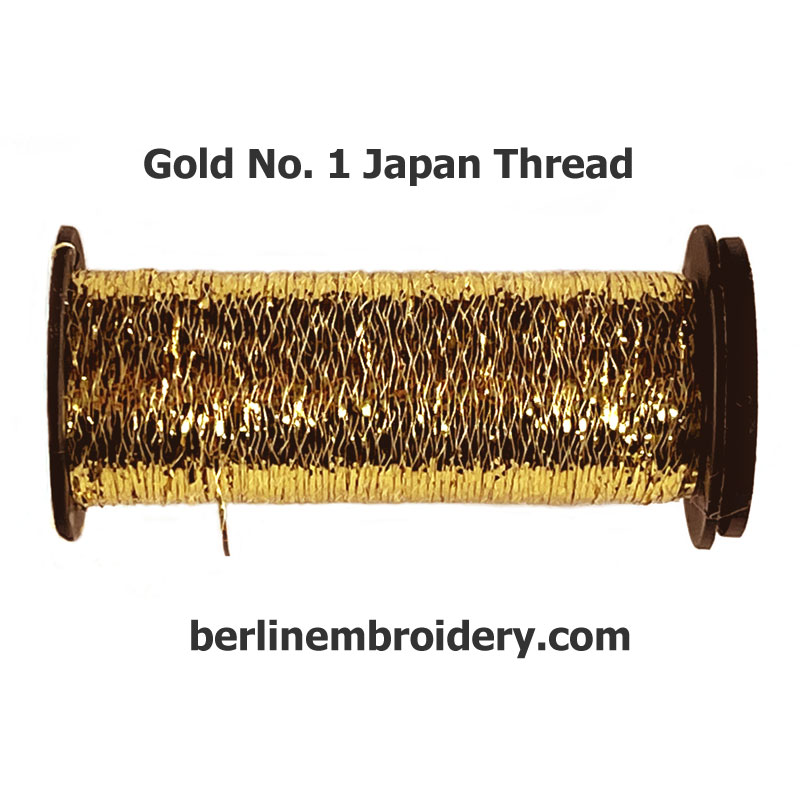
The Gold No. 1 Japan Thread is a synthetic thread with a metallic look and will not tarnish.
Please Note: The manufacturing of the No. 1 Japan thread has changed and the thread has the appearance of a fine flat foil instead of a fine cord. The thread is still strong enough for couching down metal threads.
Used for couching down other metal threads such as Check Thread, Flatworm, Japan Thread, Large Back Passing Thread, Rococco and Standard Lurex Thread.
Can also be used in combination with other embroidery threads for surface embroidery, counted thread embroidery, weaving and lace making to add sparkle.
Size: Approximately 0.3 mm across the width of the thread. 40 Meter Spool.
Gold Couching Thread – Metallic
The Gold No. 1 Japan Thread is a synthetic thread with a metallic look and will not tarnish.
Please Note: The manufacturing of the No. 1 Japan thread has changed and the thread has the appearance of a fine flat foil instead of a fine cord. The thread is still strong enough for couching down metal threads.
Used for couching down other metal threads such as Check Thread, Flatworm, Japan Thread, Large Back Passing Thread, Rococco and Standard Lurex Thread.
Can also be used in combination with other embroidery threads for surface embroidery, counted thread embroidery, weaving and lace making to add sparkle.
Size: Approximately 0.3 mm across the width of the thread. 40 Meter Spool.
$4.14 USDSelect options This product has multiple variants. The options may be chosen on the product page
$8.28 USDSelect options This product has multiple variants. The options may be chosen on the product page
Jaceron
Price Per Yard. For Random Lengths that are on Sale Click Here.
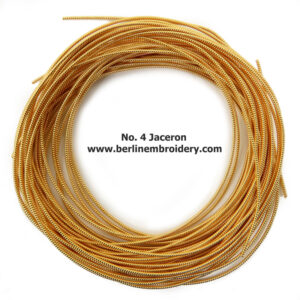
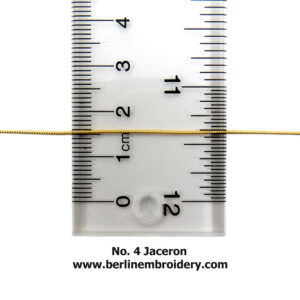
I only carry one size of Jaceron as it is almost exactly the same in appearance as Pearl Purl and is less widely used. You can substitute with Pearl Purl if I do not have the size you need in Jaceron.
Visit the Metal Thread Information page of my website for further information and pictures on how the thread can be used on an embroidery and FAQ about metal threads.
Jaceron
Price Per Yard. For Random Lengths that are on Sale Click Here.
I only carry one size of Jaceron as it is almost exactly the same in appearance as Pearl Purl and is less widely used. You can substitute with Pearl Purl if I do not have the size you need in Jaceron.
Visit the Metal Thread Information page of my website for further information and pictures on how the thread can be used on an embroidery and FAQ about metal threads.
$8.28 USDSelect options This product has multiple variants. The options may be chosen on the product page
Price range: $1.66 through $82.85 USDSelect options This product has multiple variants. The options may be chosen on the product page
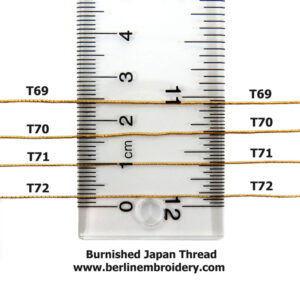
Japan Thread – British Burnished: T69, T70, T71, T72
The British made Japanese threads are burnished in colour with a mat surface giving the thread an antique look and are a high quality Japanese thread. The synthetic foil wrapped around the thread core is sturdy and is unlikely to untwist and will not tarnish.
Visit the Metal Thread Information page of my website for further information and pictures on how the thread can be used on an embroidery and FAQ about metal threads.
Japan Thread – British Burnished: T69, T70, T71, T72
The British made Japanese threads are burnished in colour with a mat surface giving the thread an antique look and are a high quality Japanese thread. The synthetic foil wrapped around the thread core is sturdy and is unlikely to untwist and will not tarnish.
Visit the Metal Thread Information page of my website for further information and pictures on how the thread can be used on an embroidery and FAQ about metal threads.
Price range: $1.66 through $82.85 USDSelect options This product has multiple variants. The options may be chosen on the product page
Price range: $3.31 through $39.77 USDSelect options This product has multiple variants. The options may be chosen on the product page
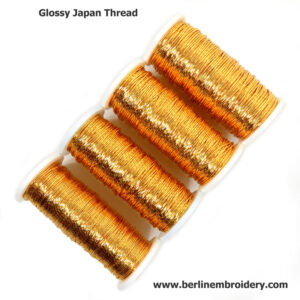
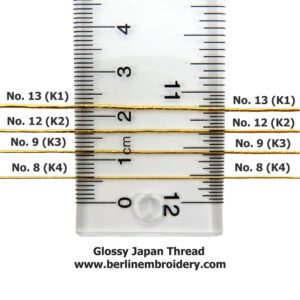
Japan Thread – British Glossy: No. 8 (K4), No. 9 (K3), No.12 (K2). No.13 (K1)
The British made Japanese threads are the goldest in colour and with the glossiest surface and the highest quality Japanese thread that I carry. The synthetic foil wrapped around the thread core is sturdy and is unlikely to untwist and will not tarnish.
Visit the Metal Thread Information page of my website for further information and pictures on how the thread can be used on an embroidery and FAQ about metal threads.
See Sale Metal Threads for shorter than 10 yard lengths
Japan Thread – British Glossy: No. 8 (K4), No. 9 (K3), No.12 (K2). No.13 (K1)
The British made Japanese threads are the goldest in colour and with the glossiest surface and the highest quality Japanese thread that I carry. The synthetic foil wrapped around the thread core is sturdy and is unlikely to untwist and will not tarnish.
Visit the Metal Thread Information page of my website for further information and pictures on how the thread can be used on an embroidery and FAQ about metal threads.
See Sale Metal Threads for shorter than 10 yard lengths
Price range: $3.31 through $39.77 USDSelect options This product has multiple variants. The options may be chosen on the product page
$5.76 USDSelect options This product has multiple variants. The options may be chosen on the product page
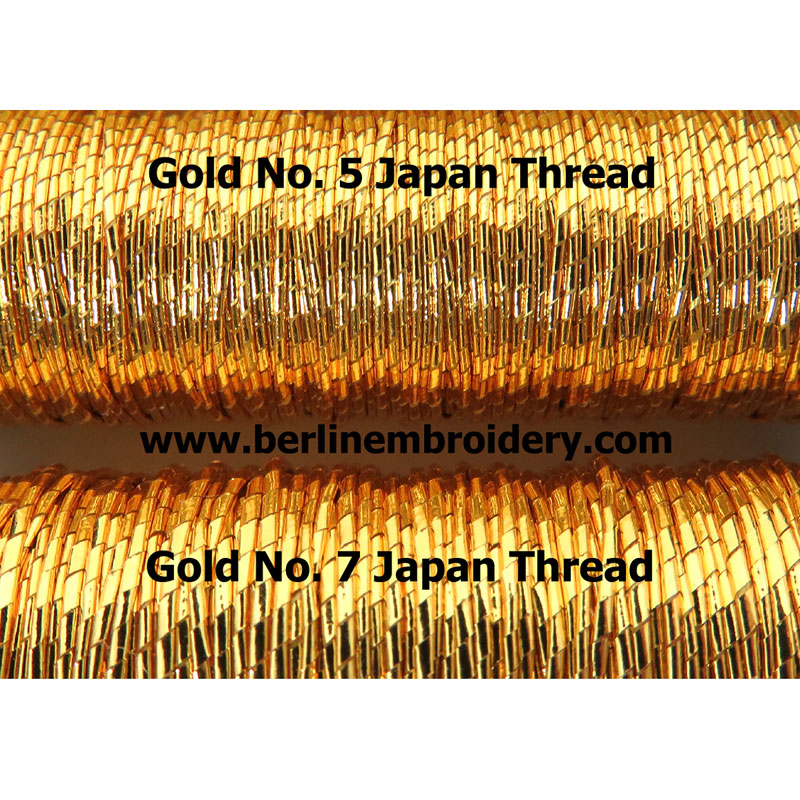
Japan Thread – Kreinik: No. 5, No. 7
Price per 40 meter spool or a 10 meter spool or skein.
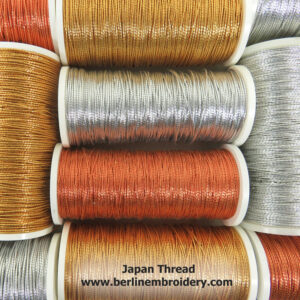
Japanese threads or Japan threads are made up of a synthetic foil wrapped around a fibre core that will not tarnish. The Kreink Japan threads are the softest of the Japan threads that I carry with the foil not as firmly wrapped around the fibre core.
Visit the Metal Thread Information page of my website for further information and pictures on how the thread can be used on an embroidery and FAQ about metal threads..
Japan Thread – Kreinik: No. 5, No. 7
Price per 40 meter spool or a 10 meter spool or skein.
Japanese threads or Japan threads are made up of a synthetic foil wrapped around a fibre core that will not tarnish. The Kreink Japan threads are the softest of the Japan threads that I carry with the foil not as firmly wrapped around the fibre core.
Visit the Metal Thread Information page of my website for further information and pictures on how the thread can be used on an embroidery and FAQ about metal threads..
$5.76 USDSelect options This product has multiple variants. The options may be chosen on the product page
Large Back
Price Per Yard.
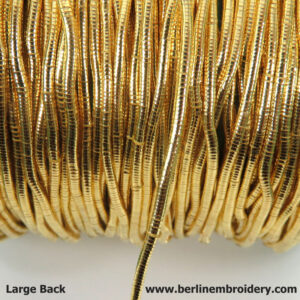
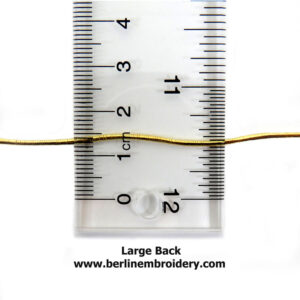
Large Back comes in one size and is similar to passing thread but much thicker (approximately 1.25 mm across the width of the thread) and is great for outlining.
The thread is rounded and smooth in appearance and turns corners easily when using a fine tipped tweezers. Large Back is couched down singularly in the same colour sewing thread or a contrasting colour.
You can substitute with Bright Gimp Cord Single Strand (Not Twisted).
Large Back
Price Per Yard.
Large Back comes in one size and is similar to passing thread but much thicker (approximately 1.25 mm across the width of the thread) and is great for outlining.
The thread is rounded and smooth in appearance and turns corners easily when using a fine tipped tweezers. Large Back is couched down singularly in the same colour sewing thread or a contrasting colour.
You can substitute with Bright Gimp Cord Single Strand (Not Twisted).
$7.87 USDSelect options
Price range: $11.60 through $18.23 USDSelect options This product has multiple variants. The options may be chosen on the product page
Lizerine (Lizardine)
Price Per Yard. For Random Lengths that are on Sale Click Here.
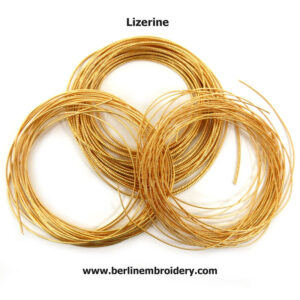
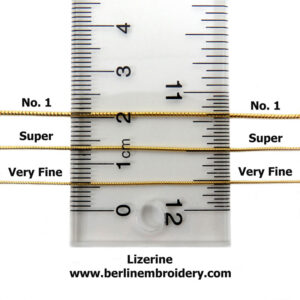
Lizerine is a wire that is wound into a tight coil that looks like a strand of gold pearls. The wire can be stretched to create different effects and used as outlines for designs or as a filling and can be combined with other threads for interesting effects. Lizerine is similar to Pearl Purl but has a squared appearance instead of rounded appearance.
Visit the Metal Thread Information page of my website for further information and pictures on how the thread can be used on an embroidery and FAQ about metal threads.
Lizerine (Lizardine)
Price Per Yard. For Random Lengths that are on Sale Click Here.
Lizerine is a wire that is wound into a tight coil that looks like a strand of gold pearls. The wire can be stretched to create different effects and used as outlines for designs or as a filling and can be combined with other threads for interesting effects. Lizerine is similar to Pearl Purl but has a squared appearance instead of rounded appearance.
Visit the Metal Thread Information page of my website for further information and pictures on how the thread can be used on an embroidery and FAQ about metal threads.
Price range: $11.60 through $18.23 USDSelect options This product has multiple variants. The options may be chosen on the product page
Metal Thread Information PDF File
I have a PDF file that you can download for the Metal Thread Information Page which has 100 pages with pictures and information on metal threads that you will find on the webpage.
This PDF is nicely laid out so that you can print off the pages you want and view the enlarged pictures of the threads against the ruler. I will email you the PDF file once I have processed your payment.
No part of the instructions can be used for commercial purposes or profited from or published without permission from Tanja Berlin.
Metal Thread Information PDF File
I have a PDF file that you can download for the Metal Thread Information Page which has 100 pages with pictures and information on metal threads that you will find on the webpage.
This PDF is nicely laid out so that you can print off the pages you want and view the enlarged pictures of the threads against the ruler. I will email you the PDF file once I have processed your payment.
No part of the instructions can be used for commercial purposes or profited from or published without permission from Tanja Berlin.
$9.94 USDAdd to cart
Price range: $0.66 through $21.13 USDSelect options This product has multiple variants. The options may be chosen on the product page
Metal Threads – Odd Lengths Sale Price
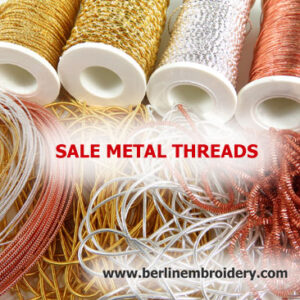
I have a selection of metal threads that are random lengths that I am selling for a bit less. The threads are in perfect condition, the same type and quality that I sell by the yard and are either the end of a manufacturing lot or shorter than the standard length: Sale Metal Threads
Please visit the Metal Threads Product Pages for all the metal threads that I carry.
Also visit the Metal Thread Information page of my website for further information and pictures on how the metal threads can be used on an embroidery and FAQ about metal threads.
Metal Threads – Odd Lengths Sale Price
I have a selection of metal threads that are random lengths that I am selling for a bit less. The threads are in perfect condition, the same type and quality that I sell by the yard and are either the end of a manufacturing lot or shorter than the standard length: Sale Metal Threads
Please visit the Metal Threads Product Pages for all the metal threads that I carry.
Also visit the Metal Thread Information page of my website for further information and pictures on how the metal threads can be used on an embroidery and FAQ about metal threads.
Price range: $0.66 through $21.13 USDSelect options This product has multiple variants. The options may be chosen on the product page
Price range: $8.28 through $16.57 USDSelect options This product has multiple variants. The options may be chosen on the product page
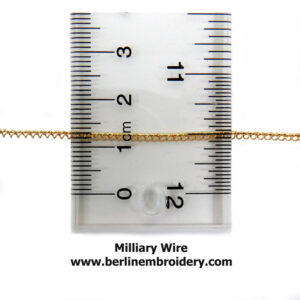
Milliary Wire Gilt
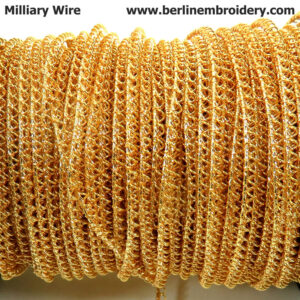
Milliary wire is a two part thread, consisting of a central core wire, with a coiled wire around it. The Milliary wire is used to outline areas of a design or in combination with other couched threads as a filling thread for designs such as leaves.
Visit the Metal Thread Information page of my website for further information and pictures on how the thread can be used on an embroidery and FAQ about metal threads.
Milliary Wire Gilt
Milliary wire is a two part thread, consisting of a central core wire, with a coiled wire around it. The Milliary wire is used to outline areas of a design or in combination with other couched threads as a filling thread for designs such as leaves.
Visit the Metal Thread Information page of my website for further information and pictures on how the thread can be used on an embroidery and FAQ about metal threads.
Price range: $8.28 through $16.57 USDSelect options This product has multiple variants. The options may be chosen on the product page
Price range: $4.97 through $20.71 USDSelect options This product has multiple variants. The options may be chosen on the product page
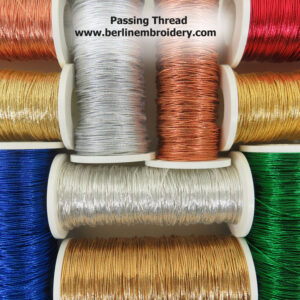
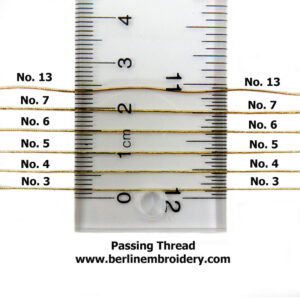
Passing Thread
Passing thread is couched down singularly in the same colour sewing thread or a contrasting colour. Passing thread is often used for Or Nue (couching down the passing thread with different colour threads to create a design or pattern on the surface of the passing thread) and underside couching.
No. 13 Passing threads are synthetic and will not tarnish.
Visit the Metal Thread Information page of my website for further information and pictures on how the thread can be used on an embroidery and FAQ about metal threads.
Passing Thread
Passing thread is couched down singularly in the same colour sewing thread or a contrasting colour. Passing thread is often used for Or Nue (couching down the passing thread with different colour threads to create a design or pattern on the surface of the passing thread) and underside couching.
No. 13 Passing threads are synthetic and will not tarnish.
Visit the Metal Thread Information page of my website for further information and pictures on how the thread can be used on an embroidery and FAQ about metal threads.
Price range: $4.97 through $20.71 USDSelect options This product has multiple variants. The options may be chosen on the product page
Price range: $9.94 through $21.54 USDSelect options This product has multiple variants. The options may be chosen on the product page
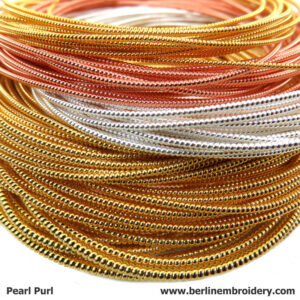
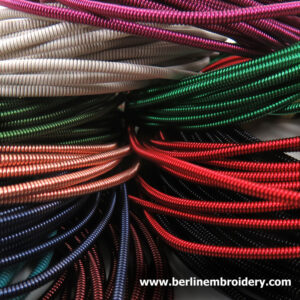
Pearl Purl
Pearl Purl is a wire that is wound into a tight coil that looks like a strand of gold pearls. The wire can be stretched to create different effects and used as outlines for designs or as a filling and can be combined with other threads for interesting effects.
The Coloured No. 2 Pearl Purls will not tarnish, but the Gold, Silver and Copper No. 2 Pearl Purls and all other sizes will tarnish.
For Random Lengths that are on Sale Click Here.
Visit the Metal Thread Information page of my website for further information and pictures on how the thread can be used on an embroidery and FAQ about metal threads.
Pearl Purl
Pearl Purl is a wire that is wound into a tight coil that looks like a strand of gold pearls. The wire can be stretched to create different effects and used as outlines for designs or as a filling and can be combined with other threads for interesting effects.
The Coloured No. 2 Pearl Purls will not tarnish, but the Gold, Silver and Copper No. 2 Pearl Purls and all other sizes will tarnish.
For Random Lengths that are on Sale Click Here.
Visit the Metal Thread Information page of my website for further information and pictures on how the thread can be used on an embroidery and FAQ about metal threads.
Price range: $9.94 through $21.54 USDSelect options This product has multiple variants. The options may be chosen on the product page
Price range: $7.46 through $9.94 USDSelect options This product has multiple variants. The options may be chosen on the product page
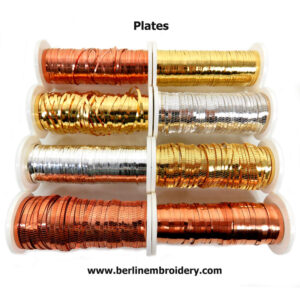
Plates
Price Per Yard.
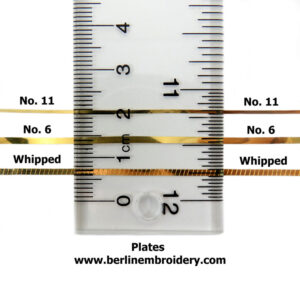
Plate is a flat metal strip which is couched down. Broad plate is smooth and shiny and whipped plate has a wire wrapped around the smooth plate at an angle giving it a serrated appearance.
Visit the Metal Thread Information page of my website for further information and pictures on how the thread can be used on an embroidery and FAQ about metal threads.
Plates
Price Per Yard.
Plate is a flat metal strip which is couched down. Broad plate is smooth and shiny and whipped plate has a wire wrapped around the smooth plate at an angle giving it a serrated appearance.
Visit the Metal Thread Information page of my website for further information and pictures on how the thread can be used on an embroidery and FAQ about metal threads.
Price range: $7.46 through $9.94 USDSelect options This product has multiple variants. The options may be chosen on the product page
Price range: $2.90 through $8.28 USDSelect options This product has multiple variants. The options may be chosen on the product page
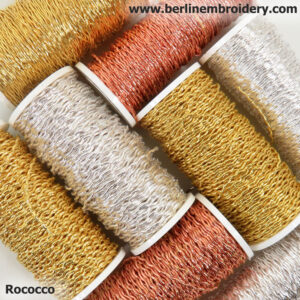
Rococco
Price Per Yard.
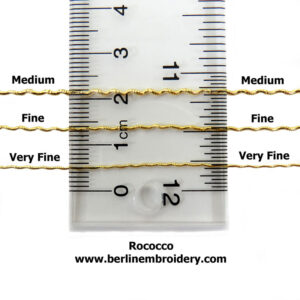
Rococco is made up of a fine metal wire wrapped around a fibre core. The wire is copper based with a gold or silver plating and will tarnish over time. Rococco has a wavy (kinked) serpentine appearance and has a more open wave than Check Thread.
Visit the Metal Thread Information page of my website for further information and pictures on how the thread can be used on an embroidery and FAQ about metal threads.
Rococco
Price Per Yard.
Rococco is made up of a fine metal wire wrapped around a fibre core. The wire is copper based with a gold or silver plating and will tarnish over time. Rococco has a wavy (kinked) serpentine appearance and has a more open wave than Check Thread.
Visit the Metal Thread Information page of my website for further information and pictures on how the thread can be used on an embroidery and FAQ about metal threads.
Price range: $2.90 through $8.28 USDSelect options This product has multiple variants. The options may be chosen on the product page
$8.28 USDSelect options This product has multiple variants. The options may be chosen on the product page
Spangles (Paillettes)
Price Per Gram.
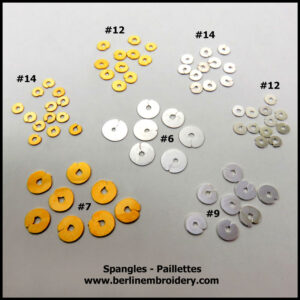
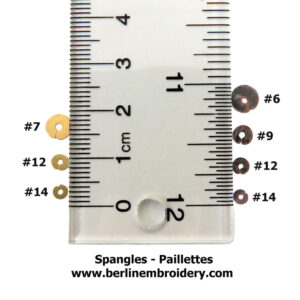
Spangles are also known as Paillettes (French term) are hard metal disk with a hole in the center, similar to a sequin but superior in quality.
Visit the Metal Thread Information page of my website for further information and pictures on how the thread can be used on an embroidery and FAQ about metal threads.
Spangles (Paillettes)
Price Per Gram.
Spangles are also known as Paillettes (French term) are hard metal disk with a hole in the center, similar to a sequin but superior in quality.
Visit the Metal Thread Information page of my website for further information and pictures on how the thread can be used on an embroidery and FAQ about metal threads.
$8.28 USDSelect options This product has multiple variants. The options may be chosen on the product page
Price range: $1.66 through $6.63 USDSelect options This product has multiple variants. The options may be chosen on the product page
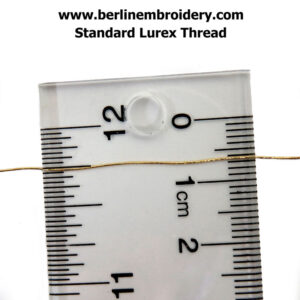
Standard Lurex Thread
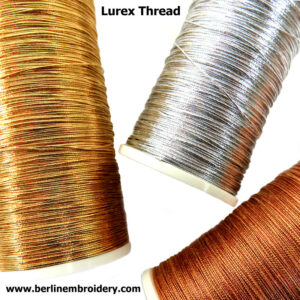
The standard lurex thread comes in dark gold No. 371, silver No. 380 and copper No. 371. Lurex thread is very similar to passing thread but with a synthetic thread wrapped around a fibre core instead of a metal thread.
The great thing about the lurex thread is that it does not tarnish but has the appearance of a real metal thread.
Visit the Metal Thread Information page of my website for further information and pictures on how the thread can be used on an embroidery and FAQ about metal threads.
Standard Lurex Thread
The standard lurex thread comes in dark gold No. 371, silver No. 380 and copper No. 371. Lurex thread is very similar to passing thread but with a synthetic thread wrapped around a fibre core instead of a metal thread.
The great thing about the lurex thread is that it does not tarnish but has the appearance of a real metal thread.
Visit the Metal Thread Information page of my website for further information and pictures on how the thread can be used on an embroidery and FAQ about metal threads.
Price range: $1.66 through $6.63 USDSelect options This product has multiple variants. The options may be chosen on the product page
$99.41 USDSelect options This product has multiple variants. The options may be chosen on the product page
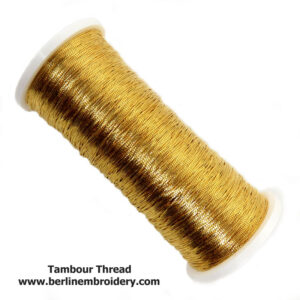
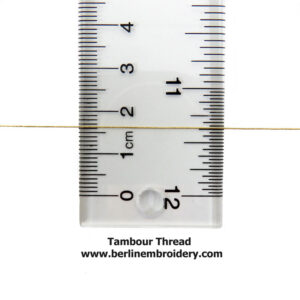
Tambour Thread
Tambour thread is a fine real metal thread that can be used for couching down other metal threads such as Check Thread, Flatworm, Japan Thread, Large Back, Passing Thread, Rococco and Starndard Lurex Thread.
It can also be used in combination with other embroidery threads for surface embroidery, counted thread embroidery, weaving and lace making to add sparkle.
If you want an alternative synthetic thread that will not tarnish then you can use the Kreinik No. 1 Japan Thread.
Tambour Thread
Tambour thread is a fine real metal thread that can be used for couching down other metal threads such as Check Thread, Flatworm, Japan Thread, Large Back, Passing Thread, Rococco and Starndard Lurex Thread.
It can also be used in combination with other embroidery threads for surface embroidery, counted thread embroidery, weaving and lace making to add sparkle.
If you want an alternative synthetic thread that will not tarnish then you can use the Kreinik No. 1 Japan Thread.
$99.41 USDSelect options This product has multiple variants. The options may be chosen on the product page

